

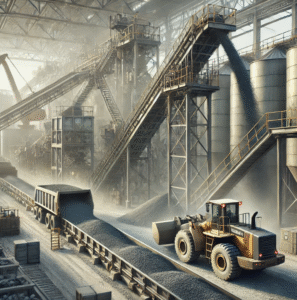
In the heart of America’s manufacturing belt, Indiana stands as a critical hub for industries like agriculture, construction, automotive, pharmaceuticals, and logistics. As businesses across the state work to increase efficiency and meet growing demands, one need becomes crystal clear: bulk material handling.
Whether it’s moving grain in an agricultural processing plant, transporting gravel at a construction site, or managing raw inputs in a production facility, bulk material handling systems aren’t just a convenience—they’re a strategic necessity. Indiana businesses that fail to upgrade or implement bulk handling solutions risk falling behind in efficiency, safety, and scalability.
Let’s explore why bulk material handling is essential for Indiana businesses that want to stay competitive and build for the future.
What Is Bulk Material Handling?
Bulk material handling refers to the storage, control, and transportation of materials in loose bulk form. Common examples include:
-
Agricultural goods like corn, soybeans, and wheat
-
Dry goods like coal, cement, and wood chips
-
Liquids like chemicals and oil
-
Powders and granules used in manufacturing and pharmaceuticals
It involves equipment such as conveyors, hoppers, silos, bucket elevators, pneumatic systems, and more—all designed to streamline movement and reduce manual labor.
Why It Matters to Indiana Businesses
1. Indiana’s Industrial Backbone Depends on It
Indiana is among the top manufacturing states in the U.S., accounting for nearly 28% of its GDP from manufacturing alone. According to the Indiana Economic Development Corporation, companies in steel production, automotive, plastics, and food processing rely on moving high volumes of material daily.
A bulk material handling system ensures raw materials are available exactly when and where they’re needed—keeping machines running and workers productive. For example, automotive component factories in Kokomo or Jeffersonville use automated material flow systems to reduce idle time and increase throughput.
2. Agriculture in Indiana Is Massive—And Demands Scale
Indiana ranks 5th in the U.S. for corn production and 4th for soybeans. These crops are stored, processed, and shipped across the globe—and none of that happens efficiently without bulk handling solutions.
From grain elevators and augers to automated silos, farmers and food processors in rural Indiana depend on fast, clean, and efficient systems to reduce spoilage, protect harvests, and meet tight delivery windows.
More advanced operations are now investing in IoT-enabled sensors and automated feed systems, enabling remote monitoring of temperature, humidity, and flow rate. These upgrades reduce labor costs and prevent costly errors during storage and transit.
3. Improved Workplace Safety
One of the most important advantages of bulk material handling is enhanced worker safety.
Manually moving heavy materials increases the risk of injuries from lifting, slipping, or equipment misuse. According to the Occupational Safety and Health Administration (OSHA), handling heavy loads improperly is one of the top causes of workplace injuries in manufacturing and agriculture.
Automated material handling equipment significantly reduces these risks by minimizing human contact with the materials, keeping operators safe and insurance costs lower.
4. Increased Efficiency and Cost Savings
Every business wants to save time and money. Bulk material handling does exactly that by:
-
Automating routine tasks like loading and unloading
-
Reducing waste from spillage and contamination
-
Speeding up the production or fulfillment process
-
Freeing up labor for more skilled, high-value tasks
For example, a food processing plant in Evansville might shift from using forklifts and pallets to a fully enclosed conveyor system. This single upgrade could result in a 40% increase in operational speed and a measurable reduction in material loss from contamination or error.
According to the Material Handling Institute, automating material handling can reduce operational costs by as much as 25–40% while increasing productivity by 20–30%.
5. Sustainability and Environmental Control
With tighter EPA regulations and a growing focus on sustainability, Indiana businesses are under pressure to minimize emissions, dust, and contamination.
Bulk material handling systems offer better environmental control than manual methods. Enclosed systems, dust collection units, and precision measurement reduce particulate matter in the air—critical for both worker health and regulatory compliance.
This is especially vital in industries like cement and aggregate processing, where dust can pose serious health and safety concerns and lead to fines or shutdowns.
Additionally, energy-efficient handling equipment contributes to corporate sustainability goals, an increasingly important factor in public perception and government contracting.
6. Scalability and Long-Term Growth
Indiana companies looking to expand need infrastructure that can grow with them.
Manual systems may work for startups or small-scale operations—but once volumes rise, inefficiencies skyrocket. Bulk material handling systems are modular and scalable, allowing for:
-
Addition of storage silos or bins
-
Extension of conveyor lines
-
Integration with production or packaging equipment
-
Software automation for real-time tracking
This flexibility makes it easier for businesses to expand without needing a complete system overhaul every time.
7. Data-Driven Decision Making
Smart bulk material handling systems now come with data and analytics capabilities. These features give Indiana businesses a competitive edge by providing:
-
Real-time inventory levels
-
Maintenance alerts to prevent breakdowns
-
Material flow tracking and traceability
-
Automated batching and quality checks
Industries like pharmaceuticals, food production, and chemical manufacturing benefit significantly from traceability, especially when adhering to FDA or USDA regulations.
Using data from your material handling systems helps optimize supply chains and forecasting, allowing you to make better decisions faster.
Conclusion
Indiana’s diverse industries—from agriculture and manufacturing to construction and logistics—are built on efficiency, safety, and the ability to scale. Bulk material handling IN is not a luxury; it’s the lifeblood of smart business operations.
Whether you’re a soybean processor in Lafayette, a chemical plant in Gary, or a warehouse distribution center in Indianapolis, investing in the right material handling systems gives you the foundation to grow faster, work safer, and operate smarter.
The future of Indiana business is automated, optimized, and data-driven—and bulk material handling is a key part of that transformation.
Helpful Authority Links:
Let your systems do the heavy lifting—literally—and give your Indiana business the edge it needs to thrive.
If you’d like help assessing the right bulk material handling solution for your facility, reach out to a trusted systems integrator or automation consultant. Your team, your bottom line, and your future will thank you.