

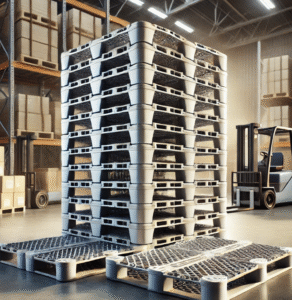
In the fast-paced world of logistics and warehouse management, efficiency isn’t just a buzzword—it’s a profit driver. One often-overlooked game-changer is the nestable pallet. These pallets, designed to interlock neatly when empty, offer significant advantages. From slashing return transportation costs to freeing up warehouse space, nestable pallets are often a silent ally for businesses aiming to optimize operations. In this deep dive, we’ll explore the practical and strategic benefits of investing in nestable pallets—backed by real-world insights, data points, and cost-saving logic.
Streamlined Return Logistics and Lower Transport Costs
Transportation is one of the largest drivers of expense in supply chain operations. Traditional solid pallets or even stringer pallets, when returned empty, occupy the same volume as when fully loaded—ushering in wasted space and needless expense. Nestable pallets solve this by stacking inside one another; in many cases, a dozen empty pallets can occupy the space of just two or three.
This translates into fewer trucks needed, lower fuel consumption, and reduced emissions—benefits that directly impact a company’s bottom line and sustainability footprint. Especially for businesses with high pallet turnover—such as beverage distribution, retail delivery, or leaf service networks—the savings can be substantial.
These efficiencies earn nestable pallets a distinct advantage over static alternatives that simply don’t make the most of every inch in warehousing or transit.
Modular Design and Enhanced Warehouse Space Utilization
A neat warehouse is a profitable warehouse. With rising industrial real estate costs, every square foot matters. Nestable pallets help businesses reclaim real estate by leveraging vertical space rather than letting pallets idle horizontally.
Moreover, reduced pallet clutter means improved maneuverability of material-handling equipment like forklifts, which speeds up picking zones and reduces labor hours. This modular design doesn’t just aid space management—it strengthens day-to-day operational workflows, keeping teams nimble and warehouses organized.
As supply chains grow increasingly complex, versatility is vital: nestable pallets integrate smoothly into automated systems, accommodate varied load types, and often pair well with rack storage solutions tailored to stacked pallets.
Longevity, Durability, and Environmental Considerations
Nestable pallets are typically crafted from quality thermoplastics such as HDPE or PP, materials known for resilience and repeated handling. While initial costs may be higher than some rudimentary wooden pallets, their long service life and uniform construction can result in durable cost-benefits over time.
These materials also lend themselves readily to recycling or refurbishment programs. Once a pallet reaches the end of its main use cycle, it can often be recycled or regrinded to create new plastic products, aligning with circular economy principles.
Given the growing emphasis on environmental responsibility and ESG (Environmental, Social, Governance) criteria, switching away from disposable or non-recyclable pallets can further benefit a company’s reputation—and potentially its compliance rating with regulators or trading partners.
Safety, Cleanliness, and Regulatory Compliance
Traditional wooden pallets can splinter, harbor pests, or absorb liquids—posing risks in product safety, contamination, and workplace injury. Nestable pallets, with smooth plastic surfaces and solid construction, offer a cleaner, safer alternative.
This physical cleanliness is critical for sectors such as pharmaceuticals, food and beverage, and high-end manufacturing. Plastic pallets are easier to sanitize and less likely to absorb contaminants—making them compliant with stringent regulations like HACCP (Hazard Analysis and Critical Control Points) and USDA food safety standards.
Reduced breakage also means fewer pallet fragments on the warehouse floor, lowering the likelihood of forklift accidents or damage to products—improving overall workplace safety and efficient goods flow.
Cost Comparison: Analysis of Total Cost of Ownership
When evaluating pallet investments, savvy businesses look beyond unit price to the Total Cost of Ownership (TCO). Nestable pallets often come with a higher upfront cost per piece, but this investment is rapidly offset by savings across multiple operational vectors:
-
Fewer return trips for empty pallets
-
Less warehouse space required
-
Lower labor needs for pallet handling
-
Longer life cycle per pallet
-
Reduced damage and waste
A comprehensive TCO analysis often reveals that, over 12 to 36 months, companies can realize tangible financial benefits—even when factoring in replacement or refurbishment cycles.
Sustainability Advantage and Corporate Responsibility
Modern consumers expect brands to embrace sustainability—and executives increasingly seek operations that can withstand ESG scrutiny. Nestable pallets support such strategies in multiple ways:
-
Reduction in carbon emissions due to fewer transport trips
-
Material recyclability and reduced deforestation vs. wooden pallets
-
Operational efficiencies that translate to lower energy use
-
A clean, hazard-free material stream that may lower disposal fees and meet circular economy norms
By implementing nestable pallets, businesses can integrate practical logistics improvements with measurable sustainability outcomes—a storytelling tool that resonates with customers, partners, and stakeholders.
Authority Perspectives from the Business World
To validate these observations, here are several established industry sources endorsing the benefits of smarter pallet strategies:
-
The Harvard Business Review emphasizes cost efficiencies through lean operations and resource optimization, which readily aligns with pallet consolidation methodologies like nesting.
-
A Forbes article on supply chain resilience highlights that operational simplicity—like standardizing on nestable pallets—can improve agility and reduce cycle time.
-
The Ellen MacArthur Foundation, a leader in circular economy insight, champions material reuse and resource-saving designs—principles that nestable pallets embody in pallet pooling and recycling schemes.
Conclusion
In an era where margins tighten and efficiency is paramount, nestable pallets emerge as both a tactical tool and a strategic asset. They yield immediate returns through reduced transport costs, better space utilization, improved safety, and lower lifecycle expenses. At the same time, they support ESG goals, cleaner operations, and corporate brand values.
Whether your business operates a vast distribution network or a smaller, precision-focused warehouse, nestable pallets offer a compelling return on investment—not just as shipping tools, but as sustainability enablers and workplace optimizers. Invest in the flexibility, resilience, and forward-thinking benefits of nestable pallets today, and stack the odds of operational excellence in your favor.