

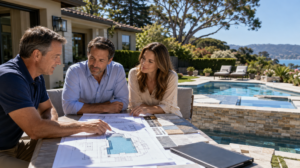
California has always been a place where design, innovation, real estate, and lifestyle intersect. Across the Peninsula, homeowners are investing in outdoor spaces that function as true extensions of the home, and a professionally designed swimming pool can become the centerpiece of that transformation. 🏡
Choosing the right pool contractor, however, involves much more than comparing a few photographs or selecting the lowest estimate. A swimming pool is a significant construction project that can involve design, excavation, drainage, structural work, plumbing, electrical systems, decking, landscaping, lighting, and long-term maintenance considerations. The company hired for the project can influence not only how the pool looks when completed, but also how naturally the entire outdoor environment works with the home.
That matters in an economically important region such as California’s Peninsula. California continues to support one of the largest and most diverse economies in the world, something reflected in Wikipedia’s overview of the California economy. Within that environment, homeowners have access to a wide range of contractors, designers, architects, landscapers, and specialty construction companies. Finding the right professional means looking beyond advertising and focusing on experience, planning, craftsmanship, and the ability to bring many parts of a project together.
The Peninsula Sets a High Standard for Outdoor Design
The Peninsula is home to communities where architecture and outdoor living often receive equal attention. A well-designed pool should feel connected to the property rather than appearing as an isolated feature placed in the backyard. The shape of the pool, surrounding materials, landscaping, lighting, seating, elevations, views, and existing architecture all contribute to the finished result.
This is one reason homeowners searching for a Pool Contractor Near Me Peninsula Area should evaluate contractors based on complete project capabilities rather than pool construction alone.
A contractor with a broader understanding of outdoor environments can consider how people will actually move through and use the property. The path from the home to the pool, shade throughout the day, entertainment areas, privacy, planting selections, retaining features, outdoor kitchens, fire elements, and gathering spaces can all affect how successful the final design becomes.
California’s continuing investment, development, and business activity also shape communities throughout the state. The California Governor’s Office of Business and Economic Development newsroom regularly reports on investment, expansion, employment, and economic activity across California. Strong regional economies often support continued investment in homes, properties, professional services, and construction, making quality and long-term value increasingly important considerations.
Experience Should Extend Beyond Building the Pool
A beautiful portfolio is valuable, but homeowners should look closely at what the contractor actually managed within those completed projects.
Some companies primarily build pools. Others can coordinate pools as part of a larger landscape and outdoor living project. That distinction can become important when a backyard transformation includes patios, planting, grading, retaining walls, drainage, lighting, outdoor structures, walkways, entertainment areas, or other elements surrounding the water.
Working with a company capable of seeing the entire property as one coordinated environment can reduce the disconnected appearance that sometimes occurs when several separate projects are completed without one overall design direction.
Experience also helps a contractor recognize challenges before construction begins. Property access, slopes, existing landscaping, drainage patterns, neighboring properties, architectural style, available outdoor space, and the location of major features can influence the design.
California’s construction environment is part of a much larger business ecosystem. The California Chamber of Commerce business headlines track economic, regulatory, environmental, transportation, and business developments affecting companies throughout the state. For homeowners, that broader environment reinforces the importance of choosing established professionals who understand the realities of operating and completing substantial projects in California.
A Strong Portfolio Should Show More Than Beautiful Water
Pool photographs naturally attract attention, especially when they include dramatic lighting, clean waterlines, waterfalls, spas, or infinity edges. The strongest portfolios reveal considerably more.
Look at the relationship between the pool and the home. Examine the hardscape around the water. Notice transitions between elevations. Consider whether plantings provide privacy without overwhelming the space. Look at lounge areas, outdoor dining spaces, pathways, steps, retaining features, walls, lighting, and architectural details.
A successful project should appear intentional from one side of the property to the other.
It is also valuable to review different types of projects rather than a collection of nearly identical pools. A contractor who has worked with contemporary homes, traditional architecture, compact properties, expansive estates, slopes, mature landscapes, and complex outdoor environments may be better equipped to respond creatively to a property’s individual characteristics.
The goal is not simply to reproduce a photograph from another home. The goal is to create something appropriate for the property, architecture, surroundings, and lifestyle of the people who will use it.
Planning Matters Before Construction Begins
Some of the most important decisions happen long before excavation equipment arrives.
The planning stage establishes where the pool belongs, how large it should be, what shape complements the property, where people will enter and exit the water, how the surrounding areas will function, and how other outdoor features will interact with it.
This stage should also account for practical considerations such as access, circulation, equipment placement, drainage, privacy, sun exposure, entertaining, and future use.
California’s broader economic data demonstrate just how much activity occurs across construction, employment, housing, business, and related sectors. The California Department of Finance Economic Indicators include information covering employment, income, construction permits, inflation, and other measurements of statewide economic conditions.
For a homeowner, careful planning translates into something much more personal. It means making thoughtful decisions before money is committed to permanent construction.
Changes on paper are usually easier than changes after concrete, plumbing, electrical work, decking, and landscaping are already in place.
Communication Can Be as Important as Craftsmanship
Large outdoor projects include many moving parts, which makes communication an important part of the contractor relationship.
Homeowners should understand who will oversee the project, how decisions will be communicated, what happens when selections need to be made, and how the contractor coordinates different phases of the work.
Good communication also helps maintain design consistency. When homeowners, designers, project managers, and construction teams share the same vision, individual decisions are more likely to support the larger plan.
Clear conversations during the early stages can establish expectations about aesthetics, budget priorities, materials, features, project scope, and how the family intends to use the finished outdoor space.
California’s business community includes millions of small businesses serving nearly every industry and market. The U.S. Small Business Administration’s California business profile provides statewide information on small-business activity and its role in the economy. Those businesses include many of the professional trades and specialized service providers homeowners depend on for major property improvements.
The quality of the working relationship therefore deserves consideration alongside the quality of the finished work.
Design Should Reflect How the Property Will Be Used
There is no single ideal swimming pool design for every Peninsula home.
A family focused on recreation may prioritize open swimming space and durable surrounding surfaces. A homeowner interested in entertaining may want the pool integrated with an outdoor kitchen, dining area, fire feature, lounge, or covered seating area. Another property may call for a serene pool surrounded by sophisticated landscaping and quiet spaces.
The design should start with the property and the homeowner’s lifestyle.
This becomes especially important on properties where outdoor square footage needs to serve several functions. A carefully developed plan can create distinct areas for swimming, dining, relaxation, conversation, play, and entertainment without making the yard feel crowded.
The swimming pool can become the visual anchor, while the surrounding landscape creates the atmosphere.
California’s ability to support businesses across technology, construction, design, hospitality, real estate, professional services, manufacturing, and countless other industries contributes to the state’s unique marketplace. Recent Los Angeles Times coverage of California business and the economy has highlighted both the scale of the state’s economy and the continued investment occurring within major California industries. That culture of design and innovation is visible throughout many Peninsula communities, including in residential architecture and outdoor living.
Materials and Details Shape the Finished Environment
The pool itself may be the largest feature, but details frequently determine whether the finished backyard feels ordinary or exceptional.
Decking materials influence the appearance of the pool and the transition to the home. Coping creates an important visual edge. Tile provides opportunities for color and texture. Lighting changes the atmosphere after sunset. Plantings soften hard surfaces and can provide privacy. Walls, steps, pathways, and elevation changes influence movement through the space.
Even practical elements such as equipment areas can be incorporated thoughtfully so they do not dominate the landscape.
Material selections should also complement the home’s existing architecture. Contemporary properties may benefit from crisp geometry and restrained materials, while other homes may call for warmer stone, softer lines, or a more natural garden setting.
The objective is visual continuity.
When the house, pool, landscape, and outdoor living areas appear to have been conceived together, the property can feel more polished and complete.
Local Knowledge Adds Value to a Peninsula Project
The Peninsula includes varied terrain, architectural styles, lot sizes, microclimates, and neighborhood characteristics. A contractor familiar with the area brings valuable context to the planning process.
Local experience can help when considering hillsides, established trees and landscaping, limited construction access, neighboring properties, space constraints, and the relationship between indoor and outdoor areas.
It also gives homeowners the opportunity to review projects completed in communities with similar characteristics.
California business conditions constantly evolve alongside real estate, construction, employment, regulation, and investment. The San Francisco Chronicle’s California business coverage provides ongoing reporting on economic and business developments affecting the Bay Area and the state. Regional awareness matters because companies working on substantial Peninsula properties operate within this larger and continually changing environment.
Choosing a contractor with an established regional presence can therefore offer benefits beyond convenience. Familiarity with the types of properties found throughout the Peninsula can influence design recommendations, project organization, and the contractor’s ability to anticipate challenges.
The Best Value Is Bigger Than the Lowest Price
A swimming pool represents a long-term improvement to a property, so price deserves to be considered in context.
The lowest proposal does not automatically provide the strongest value. Homeowners should compare what each contractor actually includes, the quality of proposed materials, the design process, the experience of the team, the level of project coordination, and the scope of work.
A proposal that appears less expensive initially can become less attractive when important elements are excluded or when separate companies must later be hired to complete the surrounding landscape.
A more comprehensive approach may create better coordination across the project and a more unified final result.
Value also includes confidence. Homeowners should feel comfortable with the contractor’s communication, portfolio, planning process, professionalism, and ability to explain the project clearly.
That confidence becomes particularly important when the project extends beyond a swimming pool into a complete outdoor transformation.
A Pool Can Become the Center of a Complete Outdoor Lifestyle
The most memorable Peninsula pools rarely stand alone.
They are surrounded by environments designed for living.
A pool may connect visually to a patio where family members gather for dinner. A spa may overlook carefully planned landscaping. An outdoor kitchen may allow hosts to prepare food without leaving guests. A fire feature can extend use of the backyard into cooler evenings. Lighting can transform the property after sunset. 🌴
Each feature becomes more valuable when it contributes to one overall experience.
This is where landscape design and pool construction naturally come together. Instead of asking where a pool can fit, the design process can determine how the entire outdoor environment should function and then position the pool as part of that larger plan.
The result can be a property that feels intentional during every season and useful for everyday family life as well as special occasions.
Conclusion
Finding the best pool contractor in California’s Peninsula Area requires more than scrolling through attractive photographs or comparing estimates. The strongest decision comes from evaluating experience, design capabilities, project planning, communication, local knowledge, craftsmanship, and the contractor’s ability to understand the property as a complete environment.
A swimming pool can be much more than a place to cool off. When it is thoughtfully designed, it can become the visual and functional center of an outdoor living space that includes landscaping, entertaining, dining, relaxation, and time with family and friends.
For Peninsula homeowners, the right contractor should bring together creativity and construction knowledge while respecting the architecture and characteristics of the property. A carefully planned project can transform an underused backyard into one of the most distinctive and enjoyable areas of the home.
California continues to be shaped by ambitious businesses, innovative design, major investment, and communities that place significant value on the way people live. Within that environment, a professionally designed pool and landscape can reflect the same attention to quality, planning, and lasting value that defines some of the state’s most impressive residential properties.